film / X-Men / retrospective
X-Retrospective — X-Men (2000)
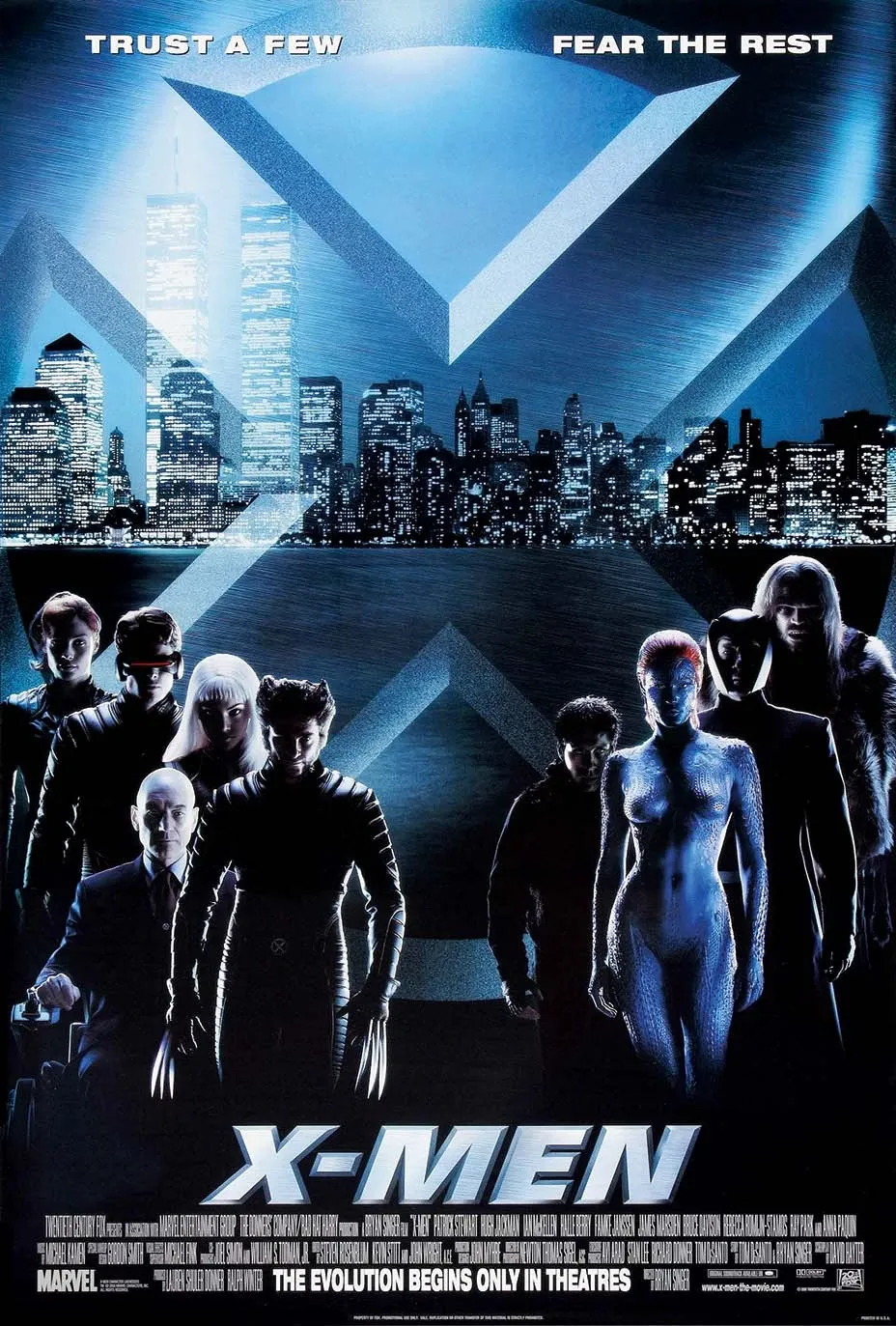
The X-Men
This is my first post here, and will be part of a series looking at X-Men media. Obviously the comic will come up, but I’m interested in everything, so we’re starting with a movie that I’d argue set in motion the current barrage of superhero movies.
The X-Men mean a lot to me; they were my favorite comic, and my favorite cartoon as a kid. I still think today they tell a lot of interesting stories, though their universe certainly sags under the weight of 60 years of fiction.
The X-Men movie in 2000 marked a turning point for both comic book movies and the X-Men. It elevated the profile of the former, and saw the latter move from bright yellow spandex to black leather.
Casting
I’m starting here because you can’t talk about the X-Men movies without touching on the casting of Xavier and Magneto. Patrick Stewart and Ian McKellen are old friends and Serious Actors. They lend a sense of gravitas1 to the production and really set it apart from superhero movies that came before this. Their chemistry on screen pops. Former friends, now enemies, they are a strong foundation for these movies to stand on.
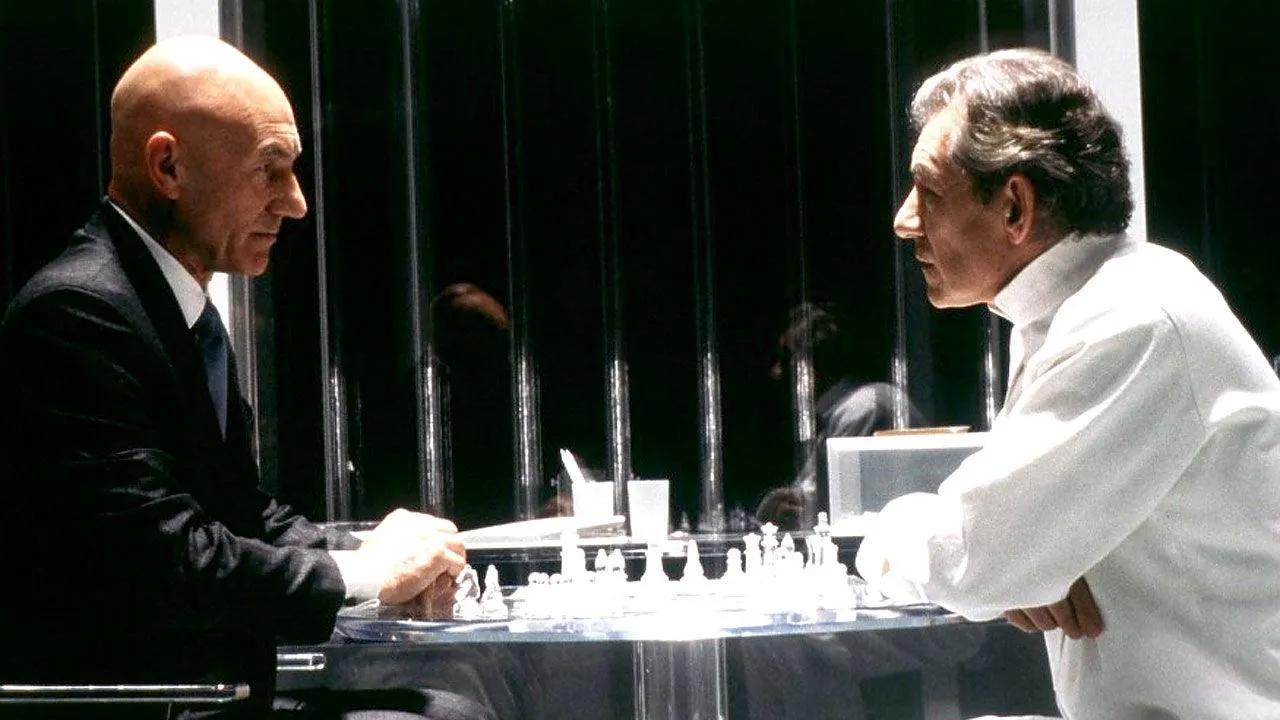
McKellen was the first actor cast and made the schedule work while also filming Lord of the Rings. McKellen had worked with director Bryan Singer on Apt Pupil and Singer told Geoff Boucher in the Los Angeles Times that McKellen was very interested in the allegory of X-Men:
As for Ian, he liked the idea of the movie because of the gay allegory — the allegory of the mutants as outsiders, disenfranchised and alone and coming to all of that at puberty when their ‘difference’ manifests. Ian is activist and he reality responded to the potential of that allegory.”
Hugh Jackman was a recast during filming after Dougray Scott was injured filming Mission Impossible II. This was Jackman’s first Hollywood role, and well, he’s gone on to no small success. It also has Anna Paquin, and Halle Berry during their ascent to stardom. It’s a really impressive list of names for a comic book movie, at least for 2000. Paquin does a great job as Rogue. That role was written very well and it does a lot to define the first two movies of this franchise.
The smaller names in the cast do a good job. Famke Janssen is a good Jean Grey. James Marsden in those red sunglasses is just incredibly punchable, A+ Cyclops casting. The supporting cast in the brotherhood is all unfortunately pretty one-note; Magneto is a great villain, and I think some later portrayals of Mystique are very good, but here everyone is pretty flat.
Casting itself was incredible2; here we have Bryan Cairns in SYFY WIRE quoting producer Ralph Winter:
Michael Jackson came in and wanted to be Charles Xavier. Shaquille O’Neal came in. He wanted to be Xavier. I remember Shaq walking through the door. I shook his hand and my hand disappeared. The guy is enormous. There was good conversation. Then, Michael Jackson came through. Not shaking hands at all, of course, but very pleasant and polite. He was fascinated with Charles Xavier, as well.
Tatiana Siegel in The Hollywood Reporter adds some detail, quoting producer Lauren Shuler Donner:
“I said to him, ‘Do you know Xavier is an older white guy?’ ” X-Men producer Lauren Shuler Donner recalls. “And Michael said, ‘Oh yeah. You know, I can wear makeup.’ ”
I don’t have the space here to get into a black Professor X, and I certainly don’t have the space to get into a whiteface Professor X, so maybe it’s best we just move on. Well, one more quote on that from Siegel’s article.
With that, Jackson queued up an elaborate presentation complete with the short film Ghosts, in which the pop star morphed into a 60-something white mayor railing against a well-meaning performer who entertains local children with magic tricks.
Production, Bryan Singer, and the Script
The movie had a $75 million budget. This was large for the time. Blade had been $45m and the first big Marvel production. The highest budget movie in 2000 was the film Dinosaur by Disney at $126m, and no, I didn’t remember it either.
Production was a mess. The movie was moved up six months and had a very short window for filming and post-production. On top of that, we need to talk about Bryan Singer.
Bryan Singer
Singer was courted for this movie, scriptwriter Tom DeSanto:
‘At first, Bryan said, ‘“‘Oh, leave me alone, I’m never going to do a comic book movie!” and I’m like, ‘No, this one’s different,”’ DeSanto told Empire magazine. Singer began reading old X-Men comics, ‘watching all seventy episodes of the animated series, reading the books, character bios and character encyclopaedias’, and soon became hooked on ‘the idea of reluctant superheroes born the way they are; outcasts, trying to find a place to belong, to be accepted. It was like finding the essence and magic of the early comics, and the darkness and the reality of the later ones, and merging the two’.
3
It seems like Singer really Got It. But it contrasts pretty sharply with his behavior on set. It was by all accounts very bad, on a lot of fronts. One of the stranger bits we hear from Hugh Jackman, speaking to Kyle Buchanan in The New York Times:
He [Kevin Feige] was slipping me some comic books under the radar because the director [Bryan Singer] didn’t want them on set.
Unfortunately, from the strange we descend into the unpleasant. In 2020 Tatiana Siegel in The Hollywood Reporter published “Bryan Singer’s Traumatic ‘X-Men’ Set: The Movie ‘Created a Monster’”, first quoted above. As you might guess, it does not paint him in a good light. What follows is a summary of that article; if you want more, read the full thing. For context remember that 2020 was the height of the me too movement, so a 20-year-old story coming out wasn’t unusual.
I will start with the most damning part of the whole story. On April 15, 1997, two boys, 14 and 17, filed a lawsuit over being forced to strip on the set of Singer’s prior movie, Apt Pupil. There were two other suits, all settled confidentially. Singer was just one of several defendants, but Fox knew about the lawsuits before hiring him, and continued to hire him in the face of incidents on the X-Men sets.
The writing of the movie was also very messy, as Siegel reports:
Despite a lineup of A-list writers, David Hayter, who served as Singer’s assistant and was answering phones in the production offices for $500 a week, received sole credit.
Hayter had recently produced and starred in the Slamdance feature Burn and was an avid X-Men fan. Singer began to rely on Hayter for his comic book knowledge, and eventually, had him writing new scenes.
The professional writers, who, by most accounts, wrote the majority of the script, ended up taking their names off it.
I didn’t cover this in casting but it seems like it was a bizarro double world. While the big roles went to a variety of established or upcoming stars, there were casting couch claims made by several on smaller roles.
Singer cast his 22-year-old boyfriend in a cameo, which one source went on to defend to Siegel:
One on-set source disputed the idea the Robitel casting was anything but professional, noting that the two had been dating for three years at that point.
If this is true, Singer started dating Robitel in 1996 when Robitel was 18, Singer was 31. Setting aside the questions raised by an age-gap relationship that starts when the younger partner is 18, this feels like a weak defense.
Additionally, 8 days after X-Men premiered, Alex Burton, who played a bit cameo role as Pyro, filed a lawsuit that he had been drugged and sexually assaulted by associates of Singer. He won that lawsuit and a $6m payment, though it’s worth noting Singer was not a defendant and as of Siegel’s article the damages had not been paid.
Singer’s drug use, temper, and mood swings caused issues on set, but with the success of the movie everything was forgiven and he was brought back for X-2. From some accounts things on set were worse for X-2 with the lead actors threatening to quit at one point, but the movie was a success and he was back for two more X-Men films.
One Final Production Note
To end this section on a lighter note, Ke Huy Quan was brought in to help with one of the action scenes during his 2-decade acting drought. He was right out of U.S.C. film school and called by the film’s action director, Corey Yuen. You can hear a little about that here, and it really reminds me of the story behind Viggo Mortensen and Lord of the Rings, filming at the same time.
Visual design
The visual design is a mixed bag. The uniforms now look dated and very early 00s. There is a clear through line from 90s films to X-Men. Blade was a success in 1998 featuring a lot of black leather. The next year The Matrix came out and its leather-clad cast were a hit.
Writer and Executive Producer Tom DeSanto4:
I was the number one champion of sticking to the real costumes, but as soon as I saw them in reality, it looked like they should be doing balloon animals at a child’s birthday party.
At the time, as a 15-year-old kid, I thought they looked really cool. With time I think everyone has soured on them a bit.
Producer Ralph Winter, in the same SYFY WIRE interview with Cairns:
At that time, we did feel like we did a good job. We limited the amount of time in the wardrobe. Of course, there’s a joke in the movie about yellow spandex, which was directed at the fans. It wasn’t to iterate them but to say “Hey, we hear you. We understand what you want. We understand you don’t like the idea of Wolverine being taller than 5’4”. We understand you’d rather have everybody in the traditional garb. But we also have to make a movie that reaches a wide audience to justify the budget.”
A short digression on Storm here, I think her design is good, and I will defend the wig.5 I know it has haters, but it works for me. It gets a little goofy when the wind and lighting are going crazy, but that also works for me.
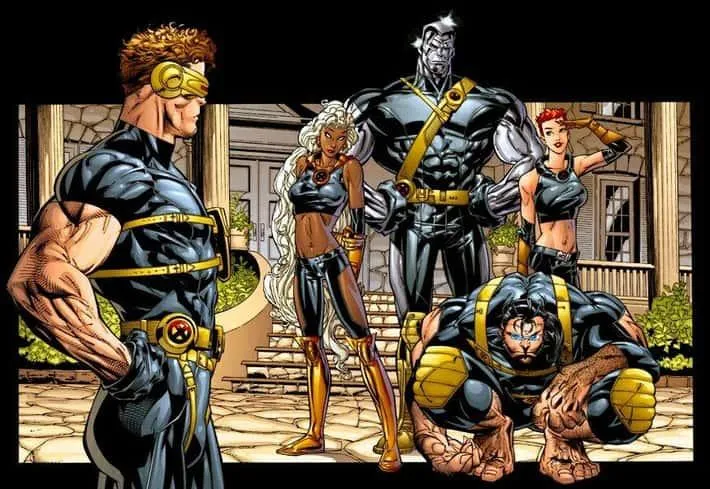
The costume design for the film likely had an impact on a more successful design, Ultimate X-Men. A comic series started in 2000, a few months after the movie. I can’t find any quotes from the writers or artists, but you can see the clear connection between the film and Ultimate X-Men.
The brotherhood cast is a mixed bag; the Mystique design for the films is inspired. Functioning as both marketing (Rebecca Romijn-Stamos is naked!) and a very cool take on the character in her natural form. She famously spent hours getting into makeup6, and her transformation VFX hold up remarkably well.
Magneto’s costume work was good. His more traditional costumes would not work in this more grounded setting. So keeping the cape and slimming down the helmet allow him to fit in while still having more flair than anyone else. It’s not my favorite Magneto costume, but given the constraints of the film’s visual design language, it’s a good bit of work.
The designers knocked it out of the park with the basement of Xavier’s school. Cerebro looks great, and the shiny metal surfaces look futuristic and slightly alien, as they should. It was very cool 26 years ago and holds up today.
I do need to criticize another part of the film’s visuals. It’s a very dark movie. This was true in 2000 but the streaming era has not been kind to it. In some scenes, like one on a train, the darkness adds to the tension. But for much of the movie, it’s just hard to see.
The Film Itself
I respect a superhero movie for opening in a concentration camp. X-Men has never been about subtlety and setting the stakes and background at the start of the movie makes a lot of sense. This movie owes a great debt to Chris Claremont. His run in the 70s really defined the X-Men and there are a lot of references to him from the writers of this film.
We get introduced to a lot of cast members pretty quickly but I think the movie does a good job setting up the world and cast for the audience. The staying power of Jackman’s Wolverine is easy to understand when he’s introduced here. We see a troubled, hurt man, but also someone who wants to help those more vulnerable than himself.
Part of the X-Men’s staying power is similar to the appeal of Hogwarts7. Kids come to this school to learn that they’re special, and I think that was a big part of the appeal when I was a kid. You come to the school to become the best version of yourself. That’s not the standard for superhero teams. Compare them to the Avengers: the Avengers are a bunch of heroes on the top of their game coming together to battle harder threats. The X-Men are a group of misfits, outcasts, and self-sabotagers, coming together to be something more than the sum of their parts. We’ve now seen countless teenage superhero squads, and they all owe something to the X-Men.
The movie only partly captures this. Rogue is the key character here, really standing in for that whole part of the lore. And Paquin and the writing pull that off.
As Chris Claremont told Benjamin Leatherman in Phoenix New Times, he sent Singer a note in 1998 saying:
It is a book about people. It is a book about outsiders and renegades trying to find a way to fit. Trying to find a future for themselves. Trying to not be the ones sent to the gas chambers.
I do want to call out one scene, later in the movie when the brotherhood are leaving a train station. Magneto is in a standoff with about 50 cops and is very unbothered. Xavier takes over the mind of Sabretooth but Magneto plays chicken with the cops’ lives and it’s just really well done, best scene in the movie.
The movie’s big showdown is set on Ellis Island; this is not subtle8. I applaud the writers for this choice. Magneto has a good monologue leading into the showdown to justify his views. Magneto’s plan is to turn a summit of world leaders into mutants, forcing them to join his side. He doesn’t know that his mutant-making machine kills everyone, making this forcible mutation plan into a “kill all the world leaders” plan. I like this as a way to escalate the stakes while making Magneto slightly less culpable.
We get that Ke Huy Quan fight scene and it’s good! Very dark, but good. Mystique is a great villain for this type of scene to keep the characters and audience guessing. The fight pretty quickly splits up the X-Men so everyone is kept guessing as to where and who she is.
The finale is in the head of the Statue of Liberty and again 10/10, excellent choice, no notes. Magneto’s turn people into mutants plan is a bit mumbo jumbo which doesn’t help things, but Wolverine saves Rogue and the world and everyone is happy.
The final scene in Magneto’s plastic prison is great. This movie really could have used more of the McKellen/Stewart dynamic.
You know this plastic prison of theirs won’t hold me forever. The war is still coming, Charles, and I intend to fight it, by any means necessary.
Reception and Legacy
The movie got generally positive critical reviews; it sits at 82% on Rotten Tomatoes with quotes that are positive, but reserved. It did very well at the box office with a $54m opening weekend going on to make $157m domestically and $296m worldwide. I don’t have any direct memories of watching it in theaters, but I know I watched and loved it at the tender age of 15. This edgier take on the X-Men was just what teens who grew up watching X-Men The Animated Series wanted, and it found broader appeal beyond that market.
David Denby in the New Yorker
First we’ll look at David Denby’s delightfully highbrow New Yorker review.
The movie might be called a struggle between the spirit of domination and the grace of noblesse oblige.
The review is fascinating to read 26 years on. He’s very high on the film. He makes a number of observations that hold up very well including that Jackman may become a star.
He doesn’t get everything right, and I think a lack of comic literacy plays a factor.
The real love match is a meeting of souls between Jackman and Anna Paquin (the girl in “The Piano”), an anguished teen-age mutant who tries to make out with her human boyfriend and winds up putting him in a coma. (One reason the mutants have to stick together is that when they inadvertently hurt each other they recover quickly.)
Anyone with a solid understanding of the X-Men will see the flaw here; he seems to be conflating Wolverine’s powers with mutants more broadly. And to be fair, Rogue does absorb those powers in this film, so I can see where he was coming from.
Roger Ebert’s Review
For a more negative take we can look at Ebert’s review.
I started out liking this movie, while waiting for something really interesting to happen. When nothing did, I still didn’t dislike it; I assume the X-Men will further develop their personalities if there is a sequel, and maybe find time to get involved in a story.
Woof. It’s an interesting review; Ebert oscillates between interest in comics and dismissal of their content and fans. Which I think also sums up his thoughts on the film. It does some stuff right, but not a lot happens. By and large, I don’t think he’s wrong. The movie’s pacing has issues thanks to the long setup.
However, his dismissal of the genre causes him to miss one of the clever bits of the plot:
How a machine could create a desired mutation within a generation is not much explored by the movie, which also eludes the question of why you would want to invest your enemies with your powers. No matter; Xavier, who can read minds, leads his good mutants in a battle to foil Magneto, and that’s the plot, or most of it.
The answer is obvious. Magneto views humans and mutants as enemies, set for war. Turning your enemies into your allies is obviously a massive coup in this world view. In Ebert’s defense, the audience is left to infer why this plan will work. His motive is not spelled out, but I think that’s better writing.
I think in a lot of ways this review holds up better than Denby’s as to the film’s quality.
Like Denby, Ebert realises this is the start of a franchise and that certainly ages well. X-Men didn’t launch a franchise; it launched a genre.
Legacy
It’s easy to look to Iron Man and the start of the MCU as the key launching point for modern superhero movies. In a way that’s right, but X-Men was a more important marker. X-Men brought Hollywood superheroes into the 21st century. It was the first major superhero movie that wasn’t campy. The first major superhero movie was an all-ages Marvel blockbuster. The first major superhero movie about a team.
Sony Pictures Chairman Tom Rothman, quoted in Siegel’s Hollywood Reporter article:
X-Men was a truly pioneering film. You have to remember, this was before Spider-Man. It was the first major Marvel adaptation to reach mainstream audiences, the seriousness with which it treated its themes of otherness, discrimination and alienation gave commercial action filmmaking a jolt of emotion and purpose.
David Denby Round Two
Surprise, I wasn’t done with Denby’s review.
I undersold the review. Denby actually is a much more astute critic than just liking a fun comic book movie. He correctly clocks that there is a shift occurring. The argument is not fully formed yet, and it couldn’t be; we were just starting a new era of action filmmaking.
But what, I wonder, will children’s fantasies be like now, in the age of “The Matrix” and the new “X-Men,” when a character who doesn’t fight in midair, walk through solid surfaces, or transform himself from a movie star into a snouted beast and back again hardly qualifies for a high-class action picture? Movies may not have become more imaginative, but they have definitely become more fantastic. A friend who loves the new, dazzlingly aerated style says we have entered an age of “visual rapture.”
Hollywood was going through an era shift. Easy access to quality CGI was a factor, as was the increasing reliance on sequels, and comic books. But I think it goes beyond that; Denby goes on to say a couple things that really triggered part of my brain.
The most striking element of visual rapture is the sight of sublime bodies flying through the air. Eroticism has been transformed into airborne athleticism.
The rippling muscles and high, round breasts of idealized comic-book figures can now be approached by these super-conditioned actors.
The seminal work on this is the excellent essay Everyone is Beautiful and No One is Horny. This essay, written 21 years after Denby’s review by Raquel S. Benedict the parallels are stunningly obvious:
Actors are more physically perfect than ever: impossibly lean, shockingly muscular, with magnificently coiffed hair, high cheekbones, impeccable surgical enhancements, and flawless skin, all displayed in form-fitting superhero costumes with the obligatory shirtless scene thrown in to show off shredded abs and rippling pecs.
Today’s stars are action figures, not action heroes. Those perfect bodies exist only for the purpose of inflicting violence upon others. To have fun is to become weak, to let your team down, and to give the enemy a chance to win, like Thor did when he got fat in Endgame.
We’re told that Tony Stark and Pepper Potts are an item, but no actual romantic or sexual chemistry between them is shown in the films.
That last one really stands out: Cyclops and Jean Grey are already an item at the start of this film. But no actual romantic or sexual chemistry between them makes it onto the screen. An earlier Denby quote points out that Wolverine’s interest in Grey goes nowhere, and the most important relationship in the film is a platonic one.
In 2000 Denby had already identified some of these trends that came to dominate the box office.
So there we have it, a very mixed legacy for a movie that just seemed like a popcorn flick when it came out at the start of the 21st century.
Footnotes
-
Hey, that’s in the blog name! ↩
-
incredible: adjective, too extraordinary and improbable to be believed ↩
-
David Hughes, Comic Book Movies (Virgin Books, 2003), p. 209. ↩
-
Hughes, Comic Book Movies, pp. 212–213. ↩
-
Of course there is at least one story of her spending those hours getting into costume only for Singer to say he couldn’t film that day ↩
-
To paraphrase Mr. Shakur - fuck that bitch and the clique she claim ↩